Preparing Your Quilt top for Longarm Quilting
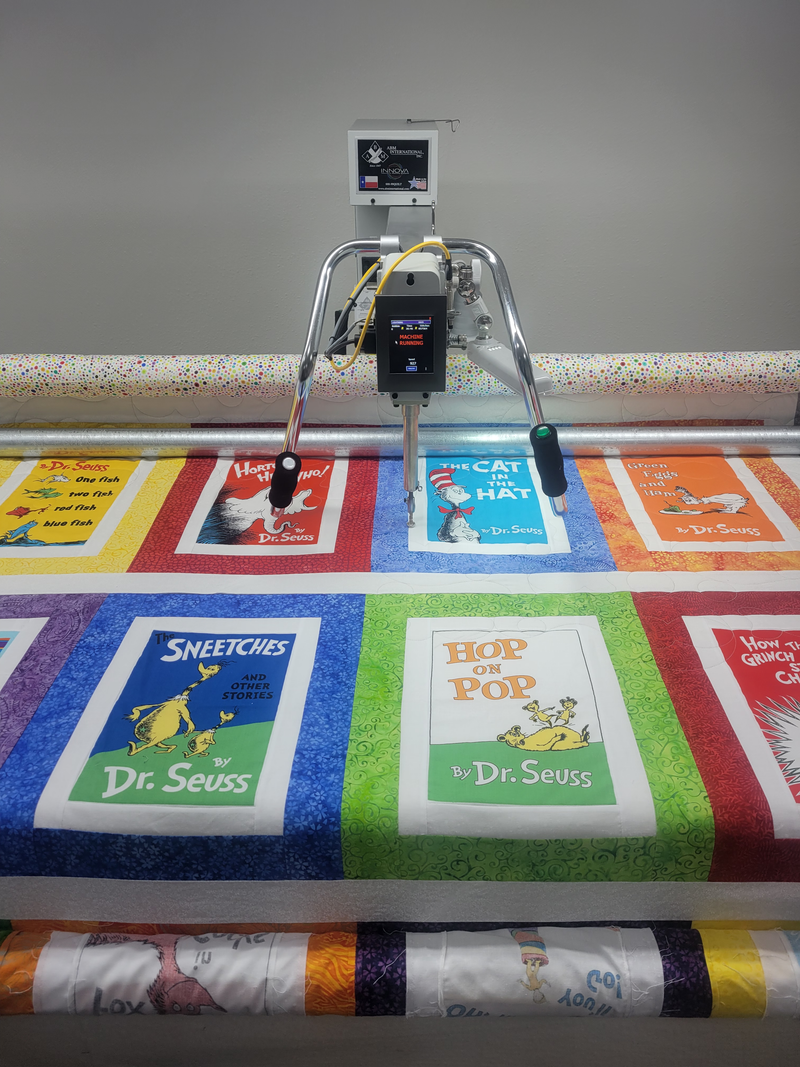
Thank you for choosing Cindy’s Longarm Quilting Service for machine quilting your special quilt top that you’ve spent so much time and love creating.
Now, let’s get it ready for longarm quilting. Before I can stitch your beauty, there is some preparation that will need to be done so you end up with the best possible results.
You might be nervous to send in your quilt to be long arm quilted for several reasons. Sending off your one of a kind, irreplaceable quilt in the mail can be concerning. But NEVER feel nervous that your quilt isn’t good enough. Each quilt arrives with hours of planning, work, love and dedication put into it and I will respect every stitch!
In order to have the best results, here is what I need to make the process as efficient and your finished quilt as beautiful as possible
Quilt top:
Check your quilt top. If the outside border has seams, they should be stitched down 1/8” from the edge. This stitching will be covered with your binding. This can be done just on the sections that have seams, or around the entire quilt if it consists of multiple seams (like a flying geese pattern or a bargello ). Check borders that they lay flat. Fullness and/or puckers within a border cannot be quilted out. Wavy borders do not give beautiful flat results.
Clip any loose threads from the underside of your quilt. If the quilt top has a light fabric, threads can easily show through. If the fabric is fraying you can use a small dot of fray check.
Make sure your quilt top is square and even on all four sides. Most quilts are not square but rectangular, so to have your quilt “square" means that the corners are 90 degrees and the sides are straight. It is helpful to do a preliminary press to make sure there are no wrinkles that could skew your measurements. On a flat surface, measure the quilt top width wise across the top, middle, and bottom. All three measurements should be pretty much the same. Then measure from top to bottom down both length sides and down the middle. Those measurements should also be the same.
Give your quilt top a good ironing. Pressing the seam allowances help it to lay flat and quilt evenly.
Fold it gently. Folding your quilt top on the bias is helpful in preventing creasing. (Do not fold the top and back together)
The Backing:
The backing fabric needs to be 8-10” larger than the quilt top both in height and width. This means that there is 4-5” extra all the way around the quilt. This is necessary for the longarm machine to hold it during quilting. If your backing isn’t large enough you can sew strips of muslin or plain broadcloth to extend the quilt back-still make sure the seam is outside the quilt top area so the machine quilting does not quilt this seam.
Backings need to be squared to be placed on the longarm quilting frame. Wide-back fabrics need to be squared.
- If your backing is pieced, make sure that all edges are cut evenly. Take time to sew those long seams carefully using pins and/or a walking foot to help achieve an even feed. The longarm cannot sew a flat quilt with uneven or twisted fabric
- Seams should be at least ½” and pressed open. Do not leave selvage edges in your seam allowance as it can cause puckering.
- It is best if seams are horizontal. Do not create a symmetrical look as it is difficult to see the back when it is on the longarm and it more than likely will not return symmetrical. Press your backing
The Batting: - Batting needs to be 4” wider and longer than the quilt top.
- Most long arm quilters use 80/20 cotton/poly blend batting. You may choose a different batting depending on the use and look. A loftier batting will show off the quilting more than a dense batting. Wool is a good choice if you really want to show off your quilting.
The quilt top, backing, and batting should all be folded separately and not folded together.
Quilting Design:
You will be able to choose your design that will be quilted on your quilt. If I have that pattern, there is no fee. If you are providing a design that I might using the future, we can split the cost. If you supply your own design pattern it needs to be in PAT format. You will also decide the density and size of the design.
Thread Color:
You can choose from a variety of thread colors. You will decide if you want your quilting to blend in or stand out on your quilt top. You will also consider the color of your backing.